Louis Prima's career began in the early 1930's, playing jazz trumpet in the style of fellow New Orleans trumpeter Louis Armstrong. Prima led his own swing band throughout most of the 30's and 40's, and starting in the mid-50's, he spent the rest of his career as a Las Vegas style entertainer. But during the late 40's and early 50's, he played a style of music closely resembling what we call rock and roll today.
Louis Prima was not an imitator of early R&B. On the contrary, many early R&B artists copied Prima. He was one of the only white artists who consistently showed up on the R&B* charts in the mid and late 40's, and many of his songs were covered by black artists. For example, Wynonie Harris, Jimmy Preston, Roy Milton, Joe Morris, and Larry Darnell all made the R&B charts with covers of Prima compositions. Prima made the R&B* charts himself with "White Cliffs Of Dover," "Robin Hood," and "I'll Walk Alone," in 1944 and '45. It's no stretch of the truth to say that Louis Prima was one of the innovators of early R&B. Just as important, he was a superstar in the Italian community, and a major inspiration for the earliest Italian rock and roll artists, some of whom, such as Jimmy Cavallo, Sam Butera, and Pat The Cat, pre-date the entrance of rock and roll into the mainstream. Cavallos first R&B records were cut in 1951, Pat The Cat's were cut in 1952. Earlier still were some 1949 R&B recordings on the X label by a very young Sam Butera, who not only was inspired by Louis Prima in the 40's, but teamed up with him in the 50's and stayed with him for decades, and still plays Prima hits to live audiences in Vegas till this day.
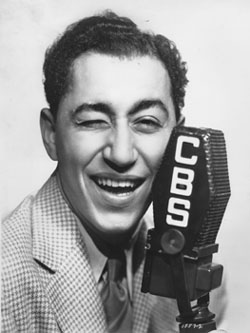
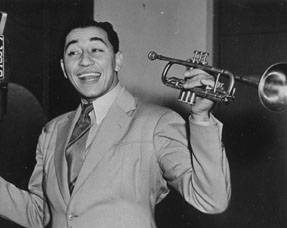
In Walt Disney's 1969 cartoon "Jungle Book," Louis Prima did the voice of the King Louis character. In the 1980's, David Lee Roth had a hit with a carbon-copy version of Prima's uptempo rendering of the old standard, "Just A Gigolo." Prima's music is experiencing another revival thanks to Brian Setzer's cover of Prima's late-1950's hit, "Jump, Jive, and Wail," and there is even a recent Gap commercial featuring Prima's version of the tune.
The selection here, musically if not lyrically, is pure rock and roll. It has the solid back beat that later would be the hallmark of rock and roll, boogie piano, and the fast dance tempo that later would become popular among teenagers.
Come On-A My House, 1950 (whole song)
*Billboard's black charts were called "Harlem Hit Parade" until June, 1949, when they were first named R&B.